
Life & Work of Textile Designer Sonia Delaunay.

Updated: Aug 23
Sonia Delaunay transformed the world of textile design with her bold use of colour and geometric patterns. Her work broke away from traditional styles and introduced a fresh, dynamic approach that influenced fashion, art, and design throughout the 20th century. This blog post explores her life, artistic journey, and lasting impact on textile design.


Sonia Delaunay 
Sonia Delaunay 
Sonia Delaunay
Early Life and Artistic Beginnings
Sonia Delaunay (born as Sarah Stern) in 1885 in Ukraine (then part of the Russian Empire). She showed an early interest in art and moved to Germany and later Paris to study painting. In Paris, she met her husband Robert Delaunay, a fellow artist who shared her passion for colour and abstraction.

Together, Sonia and Robert developed a style called Orphism (also sometimes known as Simultanism). They shared this creative partnership that focused on colour theory and abstraction. The Orphism movement explored how contrasting adjacent colours created a sense of movement, depth and rhythm. This idea was based on the theories of Eugène Chevreul, they believed that colours change depending on what colours touch them.
Robert focused this theory more on large scale abstract paintings, whilst Sonia moved her theories from painting and into fashion. This became the foundation for Sonia’s textile designs, where her artistic ideas became truly revolutionary. She reimagined what textiles could do visually and culturally for fabrics.
Transition to Textile Design
Sonia's muted brown tones were replaced by pure, vibrant contrasting colours. She used more simple shapes like flat circles and arcs with intersecting lines. She also started moving her abstract colour theories off the canvas and onto fashion, textiles, and household objects. Sonia’s move from painting to textile design was driven by her desire to bring art into everyday life. She believed that colour and form could brighten daily experiences, and not just to hang on gallery walls.
In 1910 she began creating fabric patterns that reflected her abstract paintings. Her textiles featured overlapping circles, squares, and triangles in bright, contrasting colours. These designs were unlike anything seen before in fashion or home decor.

Sonia Delaunay Painting 
Sonia Delaunay Painting 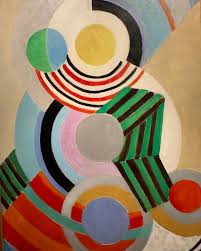
Sonia Delaunay Painting 
Sonia Delaunay Painting 
Sonia Delaunay Painting 
Sonia Delaunay Painting 
Sonia Delaunay Painting 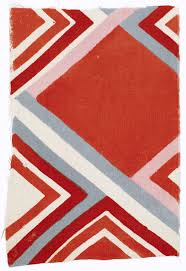
Sonia Delaunay Painting 
Sonia Delaunay Painting 
Sonia Delaunay Painting 
Sonia Delaunay Painting 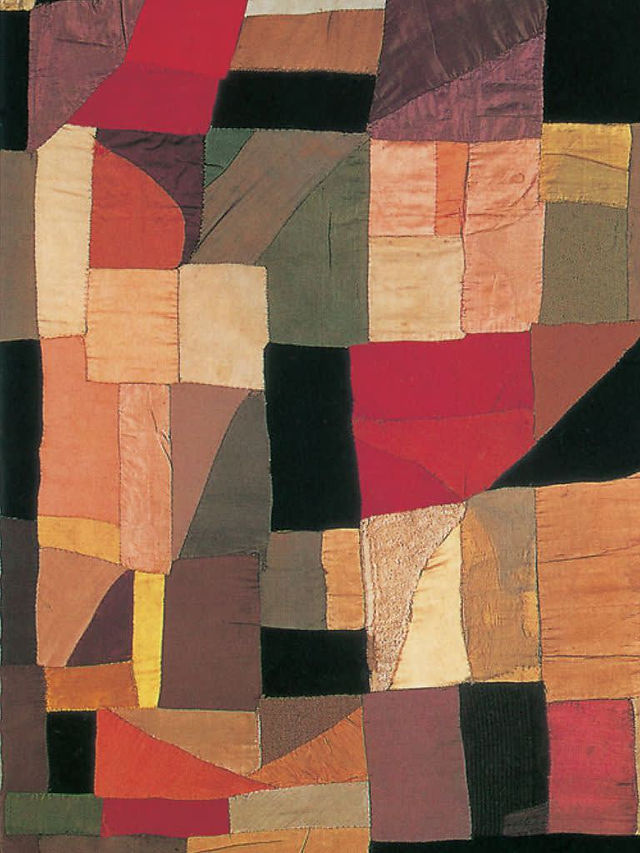
Sonia Delaunay
Key Characteristics of Sonia Delaunay’s Textile Work
Bold Colour: Sonia used strong, contrasting colours to create energy and movement in her designs.
Geometric shapes: Circles, squares, and triangles formed the basis of her patterns.
Layering and rhythm: She would use overlapping shapes that’s created a sense of depth and flow.
Integration with fashion: She designed textiles specifically for garments, making fabric an essential part of the clothing’s artistic expression.

Sonia Delaunay Dress 
Sonia Delaunay Dress 
Sonia Delaunay Dress 
Sonia Delaunay Dress
Swimming Costume Pattern Designs
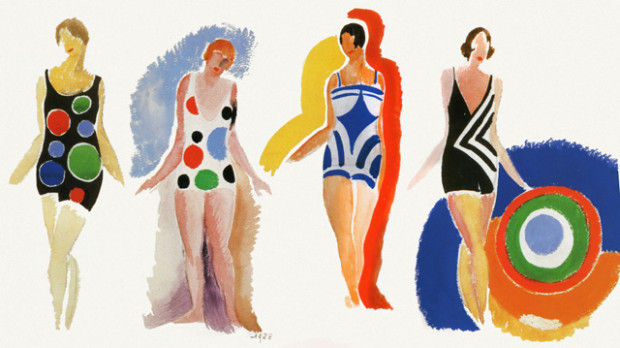

Sonia Delaunay's Swimsuit 
Sonia Delaunay's Swimsuit 
Sonia Delaunay's Swimsuit
Dress Pattern Designs

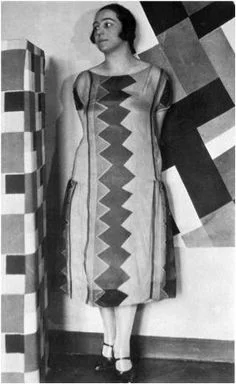
Sonia Delaunay's Dress Pattern 
Sonia Delaunay's Dress Pattern 
Sonia Delaunay's Dress Pattern

Sonia Delaunay's Dress Pattern 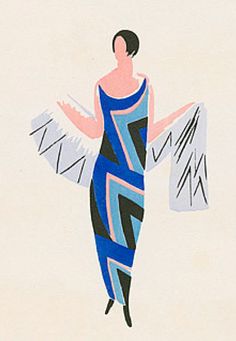
Sonia Delaunay's Dress Pattern 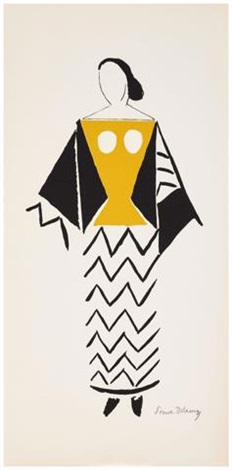
Sonia Delaunay's Dress Pattern

Sonia Delaunay's Dress Patterns 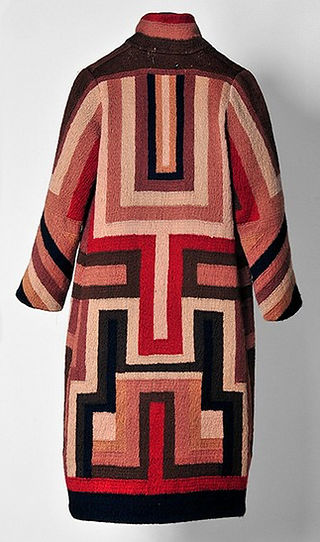
Sonia Delaunay's Coat Pattern 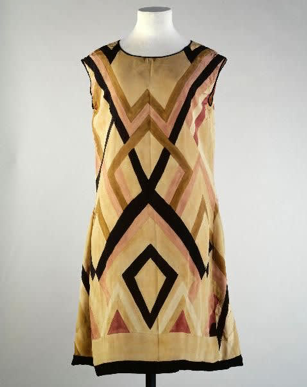
Sonia Delaunay's Dress Design

Sonia Delaunay Silk Scarf 
Sonia Delaunay Silk Scarf 
Sonia Delaunay Silk Scarf 
Sonia Delaunay Silk Scarf
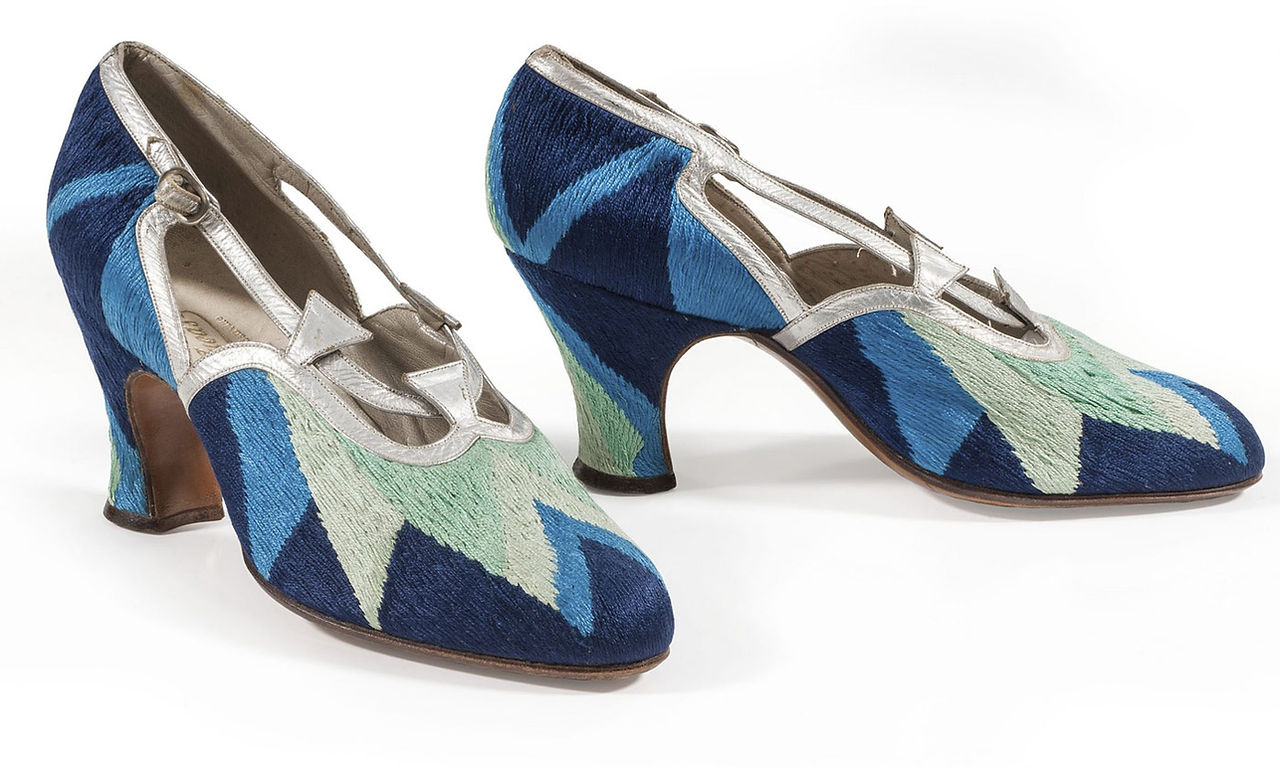
Sonia Delaunay Shoe Design 
Sonia Delaunay Shoe Design
Sonia's Impact on Fashion Design
Sonia Delaunay’s textiles caught the attention of fashion designers and artists all over the world. She was then invited to collaborate with couturiers to create dresses that were wearable art. Her work influenced the Art Deco movement and modern fashion trends.
One notable example is her collaboration with the fashion designer Paul Poiret. Together, they produced garments that combined her colourful textiles with innovative cuts, resulting in dresses that looked like moving paintings.
Sonia and Paul were two major fashion and art figures in early 20th-century Paris. Paul freed the body from tight corsets, and Sonia turned abstract art into colourful wearable clothes.
Sonia's influence extended beyond clothing. She designed scarves, upholstery, and even stage costumes, showing how textile design could cross multiple creative fields.

Sonia Delaunay Fashion 
Sonia Delaunay Fashion
Sonia continued to experiment with textiles and colour, and in the 1950s and 60s, she revisited her earlier geometric patterns, adapting them for new materials and uses.
Her work is now part of major museum collections, including the Museum of Modern Art in New York and the Centre Pompidou in Paris. Exhibitions of her textiles highlight her role as a pioneer who blurred the lines between fine art and design.

Sonia Delaunay Car Design 
Sonia Delaunay Car Design

Sonia Delaunay Dress Design 
Sonia Delaunay Dress Design
Sonia's Timeline
Across her lifetime, she produced an enormous amount of work from Paintings, drawings, fashion, textiles, prints, cars, book covers, and theatre costumes. Below is a rough timeline to show her work through the years.
1904-1906: Early Figurative Work
In 1904 she studied drawing and painting at the Academy of Fine Arts in Germany. Then she moved to Paris during 1905/06 to attend the Academie de la Palette. Her early works show traditional drawings, landscape and figurative paintings in the style of Post-Impressionism (with similar colours and bold brushwork choices of Vincent van Gogh and Paul Gauguin).

Sonia Delaunay Self Portrait 1906 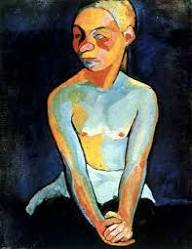
Sonia Delaunay Young Finnish Woman, 1907 
Sonia Delaunay Sleeping Girl 1907
1907-1910: Fauvism, Colour & Experimentation
During this period Sonia was living in Paris and influenced by Post-Impressionism and Fauvism. She was producing figurative paintings and portraits with bold, vibrant colours. She continues with her painting, but this sees a start to her move into interiors. In 1910 she meets and marries Robert Delaunay and together they begin working together on Orphism.

Portrait of Madame Minsky, 1907 
Sonia Delaunay Portrait de jeune fille, ca, 1907. 
Sonia Delaunay Philomena, 1907
1911- 1913: The Breakthrough with Ophism
The most pivotal transition period for Sonia, where she began applying colour relationships to her paintings, clothing, textiles, etc. Her work starts to become more abstract. This happened after she had made a geometric patchwork blanket in 1911 for her son's cot. This led to her first major simultaneous paintings and multidisciplinary avant-garde creations. She & Robert went onto to develop Orphism (also known as Simultanism) a theory based on simultanious colour contrasts and rhythmic relationships.

Sonis Delaunay's Quilt 
Sonia Delaunay Primes electriques, 1913 
Sonia Delaunay Dress Pattern
1914-1917: Spain & Portugal
This period brought about a big change for Sonia, as her and Robert had to leave France at the start of the First World War. They had to travel to Spain and Portugal. This travel inspired her, as the Portugal light intensified her colour experiments. She was also surrounded by other avant-garde artists.

Sonia Delaunay Market at minho, 1916 
Sonia Delaunay Market at minho, 1916
1917-1921: Madrid (her 'Total Art ' Period)
From 1917 and 1921 Sonia lived in the Iberian Penninsula and then Madrid. Her work became known as her 'Total Art' period - Due to the fact she mixed fine art with fashion, theatre, textiles, interiors, accessories. etc.
She established Cas Sonia, a place where her designs could be produced and sold. She works on costumes for Sergei Diaghilev's Ballets Russes production of Cléopâtre and she redecorated the Petit Casino Nightclub. She became known as a Multidisciplinary Designer.

Sonia Delaunay Cléopâtre. 
The Petit Casino, 1918
1921-1923: Back to Paris
In 1920 the Delaunay’s moved back to Paris and Sonia became increasingly involved with her Multidisciplinary Designs. Clothing wasn't simply decorated with artwork. The construction, the colour blocks and geometric rhythm became the artwork. Here her abstract geometric forms were translated into three-dimensional human movement.

Sonia Delaunay Etude de Rob 
Sonia Delaunay Miss Mouth 
Sonia Delaunay Mr Eye
1923-1925: Fashion, Theatre & Commercial Design
Sonia established her fashion and Textile enterprise, The Boutique Simultané , which was a pioneering Art Deco fashion and textile installation. It showcased Sonia's wearable abstract art, geometric patterned fabrics, and garments that merged modernism with everyday life.

Simultaneous Boutique and Studio, 1924 
Sonia Delaunay's simultaneous dresses in 1920s 
Sonia Delaunay's simultaneous dresses in 1920s
1926-1929: Film, Fashion & Textiles
Sonia designed set and costumes for Rene Le Somptier's film Le P'tit Parigot, and designed for the avant-garde colour, experimental fashion film L'Elegance. She also gave a lecture at Sorbonne 'L'influence de la peinture sur les arts vestimentaires.' Translated into English it means: 'The Influence of Painting on Clothing Arts'.

Sonia Delaunay L'Elegance 
Sonia Delaunay L'Elegance 
Sonia Delaunay L'Elegance
1930-1936: A Return to Abstraction
Sonia returned to pure abstraction, choosing to work again with circles, arcs, lines, rectangles, and spirals. She joined the Cercle et Carre and later Abstraction-Creation movements.

Sonia Delaunay 1930 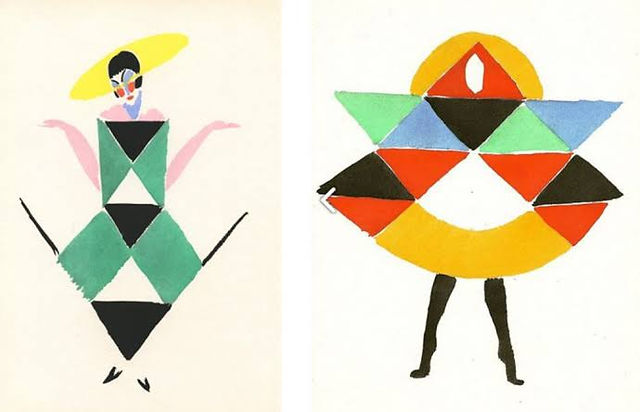
Sonia Delaunay 1930 
Sonia Delaunay 1930
1937: Paris International Exhibition
This was to be one of Sonia's biggest public commissions. Both she and Robert created large murals for the Air Pavilion and Railway Pavilion. These works of art demonstrated how their abstract colour language could operate on a grand, architectural scale.

Paris International Exposition 1937 
Sonia Delaunay 1937
1938-1941: Late Pre-War Work
During this time Sonia sought refuge in Switzerland and later devoted her energy in promoting Robert's work, whilst continuing with her own work. Sonia was now painting large-scale abstract oil on canvas, in the style of Orphism and simultaneous - Her colour rhythms.
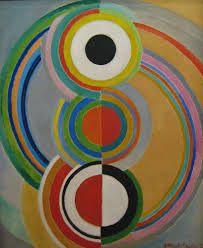
Sonia Delaunay Rhythme 1938 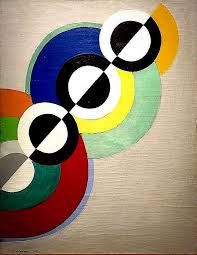
Exploring Rythme coloré by Sonia Delaunay 
Exploring Rythme coloré by Sonia Delaunay
1942-1945: The War Years
During this period, Sonia's work becomes more experimental. Sonia navigated World War Two in Southern France and then returned to a liberated Paris. She continued to develop abstraction, despite the changed circumstances around her. In this period, Sonia produced over 80 small abstract gouaches and watercolours.

Sonia Delaunay Scarf 
Sonia Delaunay Dress 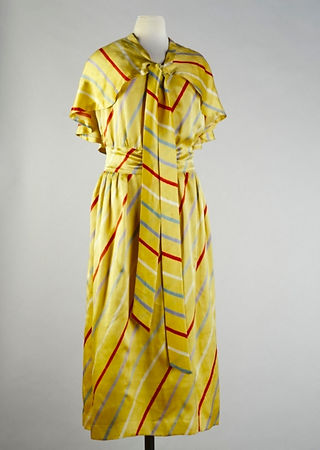
Sonia Delaunay Dress
1946-1950: Reconstruction & Renewed Abstraction
Sonia concentrated on abstraction and its promotion. She worked hard cataloguing Robert's work and arranging retrospectives to cement his role in modern art history. Toward the end of the 1940s, Sonia shifted her energy back toward her own studio practice, setting the stage for her major 1950s colour-rhythm breakthroughs.

Rythme colore (1946) Sonia Delaunay 
Sonia Delaunay. Colored Rhythm. 1953 
Rythme colore (1952) by Sonia Delaunay
1951–1959: Rythmes, colour and abstraction
Sonia continues to focus on her Rythmes-Couleurs (Rhythm-Colours) series, working on her Orphism/ simultaneous contrasts, using her landmark vibrant geometric abstractions of circles, ovals, and intersecting planes. She had captured a deep musical and visual energy in her work. In the late-1950s, Sonia would see a professional resurgence, leading to her landmark 1958 solo exhibition at the Städtisches Kunsthalle Bielefeld.

Sonia Delaunay 
Sonia Delaunay Painting 
Sonia Delaunay Painting
1960 - 1976: Her latter Years
During this period Sonia exhibits at The Fukuoka Art Museum with a six-part With Myself series. She achieves monumental international acclaim, highlighted by her historic 1964 retrospective at the Louvre Museum - as the first living female artist to be so honoured. This Resulted in her 1975 appointment as Officer of the French Legion of Honor .

Sonia Delaunay 
Sonia Delaunay
1977 - 1997: Her Passing & Her Legacy
Sonia Delaunay died in 1979 on December 5th in Paris at the grand age of 94 years old. She was be buried next to Robert's grave in Gambais, France.
She had spent roughtly 75 years of her life creating art, textiles, etc.

Sonia Delaunay
Throughout her life, Sonia continued to experiment with textiles and color. In the 1950s and 60s, she revisited her earlier geometric patterns, adapting them for new materials and uses. Her work is now part of major museum collections, including the Museum of Modern Art in New York and the Centre Pompidou in Paris. Exhibitions of her textiles highlight her role as a pioneer who blurred the lines between fine art and design.

Sonia Delaunay Exhibition
What have designers & artists learnt from Sonia Delaunay today?
For designers and artists today, Sonia’s work offers several valuable lessons:
We have learnt not to be shy to embrace bold colours with strong contrasts and vibrant hues.
To think beyond traditional pattern styles and use shapes and layering to create dynamic textiles designs.
Experiment with Integrating art with function, in order to design textiles that enhance the garments they cover.
Endeavour to collaborate across disciplines, and work with fashion, interior design, and other fields to expand your creative impact.
To practice working on colour experimentation and geometric compositions.

Her approach encourages creativity that is both visually striking and practical. Sonia Delaunay dismantled the barrier between fine art and textile design. Prior to Delaunay, there was a much clearer distinction between: Fine art (painting, drawing, sculpture) and Applied/decorative art (textiles, clothing, furniture, interiors).
Period | Approx. dates | Main language |
1. Academic/Figurative | 1904–07 | Portraits, figures, landscapes |
2. Fauvist Colour | 1907–10 | Bold colour, expressive painting |
3. Simultanism begins | 1911–13 | Circles, contrasts, simultaneous colour |
4. Total Art | 1914–21 | Painting + textiles + fashion + interiors |
5. Poem Dresses & Fashion | 1922–29 | Geometry translated into clothing |
6. Pure Abstraction | 1930–38 | Geometric rhythm and colour |
7. War & Reconstruction | 1939–50 | Gouache, collage, abstract composition |
8. Rythmes-Couleurs | 1950–69 | Colour, repetition, prints, textiles |
9. Late Abstraction | 1970–79 | Highly distilled colour/rhythm |

Sonia Delaunay transformed modern art by co-establishing the Orphism movement and dissolving the barriers between fine art and daily life. She demonstrated that abstract colour theory and geometry are as suitable for fabrics, clothing, and interiors as they are for traditional canvases.
Over a century later, Sonia continues to be highly relevant to surface pattern designers, not just as a notable figure in art history. Her impact endures because modern designers are still heavily influenced by her work. Contemporary fashion, interior design, and graphic arts are still proving that abstract fine art can merge seamlessly with everyday functional life. Sonia's pioneering concepts of Orphism/simultaneous colours and wearable art laid the structural groundwork for modern design democracy and multi-disciplinary creativity today.

Sonia Delaunay: Born on November 14, 1885
Born Sarah Stern in Ukraine to poor parents, and by the age of 5 she was orphaned. She later moved to Saint Petersburg, where she was cared for by her mother's brother, Henri Terk, who later went onto adopt her.
She lived a remarkable 94-year life defined by vibrant geometric abstraction
across painting, fashion, and textiles, and who also co-founded, with her husband, the Orphism art movement.
She died in Paris on December 15th, 1979.
Sonia & Robert's only child, Charles Delaunay (born 1911),
went onto become a world-famous jazz promoter, writer, and critic.
He also co-founded Europe's first jazz magazine, Jazz Hot,
& helped launch Quintet of the Hot Club of France featuring Django Reinhardt.
In 1948 Charles founded the record label Disques Vogue.
A large scale tapestry by Sonia Delaunay, dated 1969, hangs on the first floor near the staircase
inside the Institut Français building located at 17 Queensberry Place in London.

Sonia Delaunay's Tapestry
in 1984 US fashion designer Perry Ellis devoted his fall collection to Sonia Delaunay,
producing knits and prints in Delaunay colors and patterns.

Perry Ellis 
Perry Ellis 
Perry Ellis
In 2004, Sonia Delaunay's painting Coccinelle was featured on a stamp
jointly released by the French Post Office, La Poste and the United Kingdom's Royal Mail
to commemorate the centenary of the Entente Cordiale

Sonia Delaunay Stamp
Where to see her work today
Musée d’Art Moderne de Paris, Paris
Musée d’Art Moderne de Paris, Paris
Palais Galliera, Musée de la Mode de Paris, Paris
Centre Pompidou, Paris
Museum of Modern Art (MoMA), New York
Tate, London
Victoria and Albert Museum, London
Cooper Hewitt, Smithsonian Design Museum, New York
Museo Nacional Thyssen-Bornemisza, Madrid
Museo Nacional Centro de Arte Reina Sofía, Madrid
Stedelijk Museum, Amsterdam
Museum Folkwang, Essen
Museum Ludwig, Cologne
Louisiana Museum of Modern Art, Humlebæk
Textiles & Fashion
Ideal for surface-pattern research.
Palais Galliera, Paris
Victoria & Albert Museum, London
Cooper Hewitt, New York
Musée d'Art Moderne de Paris, Paris
Paintings and Colour Theory
MoMA, New York
Musée d'Art Moderne de Paris, Paris
Centre Pompidou, Paris
Tate, London


