
How Cubism Challenged Convention and Influenced Art

Updated: Apr 28
The Birth of Cubism
Cubism is one of the most important modern art movements, developed in the early 20th century and spearheaded by Pablo Picasso and Georges Braque in Paris. It rejected traditional perspective, breaking down objects into geometric, fragmented forms and presenting multiple viewpoints simultaneously to emphasize the flat surface of the canvas. Picasso and Braque were the central figures behind Cubism. They didn’t just contribute to the movement; they created it together. Around 1907-1914, Picasso and Braque worked so closely that their paintings became almost indistinguishable. They shared ideas, experimented with reducing objects to geometric forms together. This period is often described as one of the most important artistic partnerships in history. Their collaboration was all about challenging the traditional perspective.

Pablo Picasso & Georges Braque 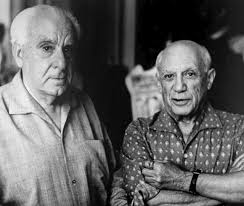
Pablo Picasso & Georges Braque
Picasso and Braque: The Originators of Cubism
Although the two worked closely together, Pablo Picasso and Georges Braque both had slightly different approaches. Picasso was more experimental and bolder, and he often pushed ideas further and in new directions. Braque was more controlled and systematic, and focused on structure and balance. Together they invented a completely new visual language that changed how space, form, and perspective work in art. Cubism then went on to influenced nearly every modern art movement that followed.

Pablo Picasso
Pablo Picasso's painting Les Demoiselles d’Avignon (1907) is often seen as the starting point of Cubism as it breaks figures into sharp, angular forms, shows multiple viewpoints and rejects traditional realism. this painting is a groundbreaking masterpiece that launched modern art and early Cubism by depicting five nude, angular prostitutes in a Barcelona brothel. The large-scale painting shattered artistic conventions with sharp geometric planes, African mask-inspired faces, and distorted bodies, challenging traditional perspectives of beauty and space

George Braque
George Braque quickly picked up these ideas and began exploring them in landscapes and still lives. Braque's Cubist landscapes, alongside Pablo Picasso, revolutionized art by deconstructing nature into geometric shapes, muted tones, and flattened planes. Inspired by Cézanne, his early works, like Trees at L'Estaque (1908) prompted the term 'cubism' due to their 'little cubes' and unconventional perspective.
Paul Cézanne: The Main Influence of Cubism
One primary influence that led to Cubism was the representation of three-dimensional form in the late works of Paul Cézanne. Cézanne set up the ideas that cubist artists later pushed much further. This was in the form of simplifying what he saw into basic shapes. For example: his trees became cylinders, his mountains became cones and his fruit became spheres. It was this idea of reducing reality to geometry is a direct stepping stone to Cubism.
Cézanne challenged traditional perspective, instead of using one fixed viewpoint like Renaissance art, Cézanne shifted angles slightly and showed objects as if seen from multiple positions. therefore, creating an unstoppable space. Cubists just took this further and showed multiple viewpoints all at once.
He focused on structure over realism and the cubists turned this into a full system of fragmenting objects into planes. He also simplified colour and form, by using less detail, and more emphasis on mass and volume. He used colour to build form rather than decoration. This influenced Cubism’s early muted, structured style (Analytical Cubism).


John Edward Hollen: Still Life: Bowl with Fruit and Wine Glass 
Pablo Picasso, Still Life: Fruit Dish and Pitcher
Characteristics of a traditional Painting
Realistic representation of objects.
A single view.
Use of perspective and depth.
Natural colours and shading.
Focus on capturing the appearance of reality.
Characteristics of a Cubist Painting
Objects broken into geometric shapes.
Multiple viewpoints shown at once.
Flattened space (less depth).
The use of limited, muted colours.
A focus on structure & form rather than realistic appearance.
Deconstructing objects into geometric shapes
The core idea is that Cubism shows objects from multiple viewpoints at the same time, instead of one realistic perspective. Forms are broken up into geometric shapes like cubes and triangles and then reassembled in an abstract form. Instead of depicting objects from a single perspective, the artist depicts the subject from multiple perspectives to represent the subject in a greater context

Jean Metzinger cubism sketch 
Jean Metzinger cubism painting
Cubism's main traits include
Geometric Shapes
Objects are broken down into cubes, triangles, and planes
Forms look fragmented rather than smooth or realistic
Multiple viewpoints
Shows different angles of an object at the same time
Instead of one perspective, you see several combined
Flattened pace
Little or no depth
Background and foreground often blend
Rejects traditional perspective used since the Renaissance
Limited Colour
Mostly browns, greys, muted tones in Analytical Cubism
Focus is on form, not colour
Fragmentation
Objects are broken into smaller parts and rearranged
Can make subjects hard to recognise
Use of Collage
Real materials like newspaper, labels, wallpaper added
Mix of painting and real-world elements
Structure over Realism
Emphasis on how objects are constructed, not how they look
Moves away from copying reality
Cubism Consists of two Primary Phases

Analytical Cubism
(c. 1907–1912)
-----------------------------------------
Subjects were broken down into sharp, geometric, often monochrome, and fragmented planes. Instead of showing a single, realistic perspective, it tries to analyse how we perceive an object in space and time.
fragments: Objects (people, instruments, bottles, etc.) are broken into small geometric shapes
Multiple viewpoints: The same subject is shown from different angles simultaneously.
Limited colour palette: Mostly browns, greys, ochres, and muted tones to focus attention on structure rather than colour.

Synthetic Cubism
(c. 1912 onward)
-----------------------------------------
A more playful, colourful style that used collage to synthesise fragments from the real world into the art.
Simpler shapes & clearer forms: Objects become more readable again and less fragmented than earlier Cubism.
Brighter, more varied colour: Unlike the muted browns & greys of Analytical Cubism, Synthetic Cubism often uses bold, expressive colours.
Collage technique: Adding newspaper clippings, wallpaper pieces, sheet music and printed text.
Mixed reality & art: By using actual materials, the artwork blends, challenging the idea that painting had to imitate reality.
A Brief Comparison of the two Cubism Styles

Analytical Cubism 
Synthetic Cubism
Analytical Cubism breaks objects down into fragments.
Subject is analysed and broken down into many small geometric forms.
Multiple viewpoints shown simultaneously.
Muted, monochromatic colour palette (browns, greys, ochres).
Complex, fragmented, and hard to recognise the subject.
Focus on structure and form.
Synthetic Cubism builds objects up using shapes, colour, & real materials
Subject is synthesised and built up using shapes and planes
Fewer, larger geometric forms.
Brighter colours and greater contrast.
Collage introduced (newspaper, wallpaper, printed materials).
Subject more recognisable.
Focus on arrangement and composition.
Pablo Picasso
Pablo Picasso co-founded Cubism (circa 1907–1914) with Georges Braque, revolutionizing art by breaking objects into geometric, fragmented forms viewed from multiple perspectives simultaneously. Picasso pioneered Analytical Cubism (fragmented, monochromatic shapes) and later invented Synthetic Cubism (incorporating collage/mixed media) to reintroduce reality into his compositions.

Georges Braque
Georges Braque co-founded Cubism with Pablo Picasso around 1907-1908, pioneering the fragmentation of objects into geometric forms and multi-faceted perspectives. He shifted from Fauvism to a muted, analytical style, focusing on structure, still life's, and pioneering pasted paper collage in 1912, fundamentally changing how space and texture were represented in art.

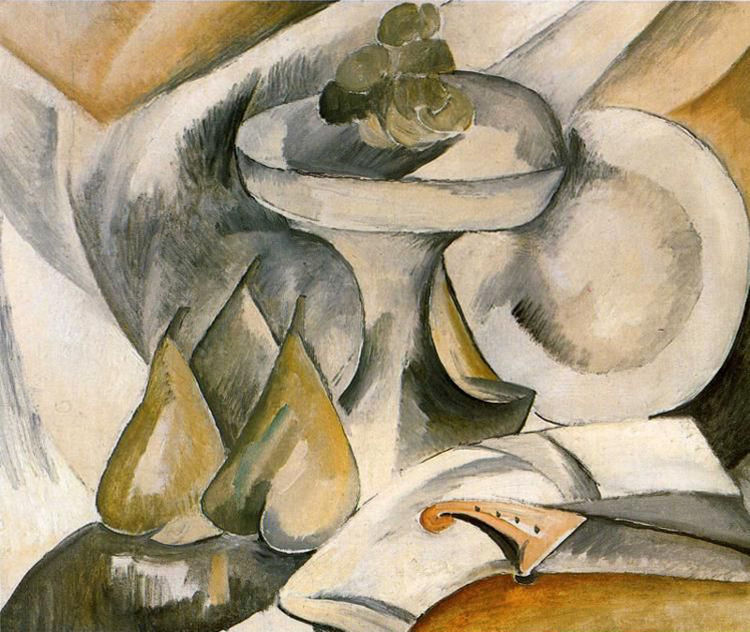
Albert Gleizes
Albert Gleizes (1881–1953) was a foundational French painter and theorist who helped define and popularize Cubism, shifting it toward a more public, analytical style. He co-authored the first major treatise on the movement, Du Cubisme in 1912 with Jean Metzinger, founded the Section d' Or group, and introduced bold, large-scale, and colourful geometric abstractions.


Jean Metzinger
Metzinger was a central theorist, painter, and founding member of the Salon Cubists (Section d'Or) who helped define Cubism's conceptual framework, notably inventing mobile perspective. He co-wrote Du Cubisme in 1912 with Albert Gleizes, the first major treatise on the movement. Metzinger’s work, which transitioned from Neo-Impressionism to a structured, geometric style, was pivotal in developing the Crystal Cubism phase.


Juan Gris
Juan Gris was a pivotal figure in the Cubism movement, renowned for pioneering Synthetic Cubism and developing a more structured, colourful, and classical form of the style. He utilized paper collage, including wallpapers and labels, to blend reality with abstract, geometric structures in his still-life compositions.


Sonia Delaunay
Sonia Delaunay was a pivotal figure in transitioning Cubism toward vibrant abstraction, co-founding the Orphism (or Orphic Cubism) movement alongside her husband, Robert Delaunay. She moved beyond the monochrome style of early Cubism, applying theories of simultaneous colour contrast to create dynamic, rhythmic, and brightly coloured geometric compositions in painting, textiles, and fashion.


Fernand Léger
Fernand Léger developed a unique, machine-inspired form of Cubism known as Tubism, characterized by bold, cylindrical shapes and vibrant colours that reflected modern industrial life. He stood out from conventional Cubists by emphasizing mechanical forms, bold colour contrasts, and a mechanical aesthetic to depict figures and landscapes.


A Visual Timeline of a violin

Evert Collier, 1700 
William Michael Harnett, 1886
1700
Artist: Evert Collier
Title: Vanitas still life with a violin, recorders, music manuscripts, and a globe
Medium: Oil on Canvas
1886
Artist: William Michael Harnett
Title: The Old Violin
Medium: Oil on Canvas

George Braque 1910 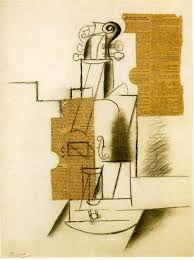
Pablo Picasso 1912
1910
Artist: George Braque
Title: Violin and Candlestic
Medium: Oil on Canvas
1912
Artist: Pablo Picasso
Title: Violin
Medium: Charcoal, Collage, Cardboard

Jaun Gris, 1918 
Michael Leu, 1950
1918
Artist: Juan Gris
Title: Violin and Glass
Medium: Oil on Canvas
1950
Artist: Michael Leu
Title: Violinst and Model
Medium: Colour Lithograph

Jaun Gris, 1964 
Roy Litchtenstein, 1997
1964
Artist: Juan Gris
Title: Still Life with Violin
Medium: Oil on Canvas
1997
Artist: Roy Lichtenstein
Title: Cubist Cello
Medium: Oil on Canvas
How Cubism Changed Art History
Cubism revolutionised art by shattering the 400-year-old tradition of single-point perspective. It introduced a new visual language that involved analysing objects as fragmented, geometric shapes and depicting them from multiple viewpoints simultaneously. This shifted art from imitating nature toward conceptual, abstract representation. Areas that changed were...
Destroying Traditional Perspective
Before Cubism, artists used one fixed viewpoint (as though looking through a window). Cubism changed the idea that art must imitate how the eye sees. Instead, Cubism showed multiple viewpoints at once and fragmented, shifting perspectives.
Objects into Geometric Forms
Picasso and Braque moved art away from realism toward abstraction. They broke objects into geometric shapes, such as: cubes, triangles and planes.
Changing what Art could include
In Synthetic Cubism, it helped lead to modern mixed media & conceptual art. Artists started to introduced collage (such as newspapers, wallpaper and lables) into their art.
Shifting the Centre of Modern Art Thinking
This changed how artists across Europe and later America approached art. Cubism showed that reality is not fixed visually. That art can be conceptual, not just representational. Plus, art can have multiple viewpoints.
Cubism Influence in Art History
Cubism’s influence marks one of the biggest turning points in art history, because it permanently changed what art could be and how artists could think. After Cubism, the idea that art had to imitate reality no longer held authority. Instead, artists began to see painting to construct reality rather than copy it. Objects could be broken apart, reorganised, or completely removed, opening the door to abstraction.
Nearly every major modern movement developed in response to Cubism’s breakthroughs. Futurists adapted its fragmented forms to express speed and modern energy, while Orphists and Synchromists pushed its abstraction toward pure colour and rhythm. Constructivists and Suprematists reduced its geometry further into functional or spiritual forms, and later movements like Abstract Expressionism embraced its rejection of realism to focus on emotion and gesture.
Beyond painting, Cubism also reshaped architecture, design, and visual communication by introducing geometric simplification and collage-like thinking. It encouraged artists to experiment freely with materials, structure, and perspective.
Cubism created a new style and changed the purpose of art. It shifted modern creativity toward abstraction, innovation, and conceptual thinking, laying the foundation for virtually all 20th-century avant-garde movements that followed.
Opening the door to abstraction
Without Cubism, modern abstract art may not exist in the same way. Cubism didn’t fully abandon objects at first, but it did pave the way for pure abstraction, influencing other art movements, such as..
Fauvism (c. 1905)
Cubism ( c.1907)
Futurism (c. 1909)
Orphism (c. 1912)
Synchromism (c. 1912 - 1913)
Constructivism (c. 1915 - 1920)
Suprematism (c. 1915)
Abstract Expressionism (c. 1940)
De Stijl (Neoplasticism) (c. 1917)
Over the next several months I shall be writing about the the other art movements that came out of Cubism.
Rachel Goodchild | Design Blog
Creating Pattern for Textile, Product, Home & Packaging


