.png)
What Early Cave Art Reveals about Creativity and Expression
- Rachel Goodchild

- Jan 23
- 11 min read
Before Paint Tubes and Art Schools, There Was Firelight and Stone.

Prehistoric cave paintings are ancient artworks, often found deep in caves, depicting animals, humans, and symbols, created by early humans, using natural pigments like ochre and charcoal. Discoveries of these caves have been found in Spain, France and Indonesia, with dates thought to go back as far as 40,000 - 64,000 years old. These paintings have revealed early storytelling, ritualistic practices, and sophisticated artistic skills. Spanning the Palaeolithic era, these paintings offer invaluable insight into prehistoric life, beliefs, and the dawn of human creativity.
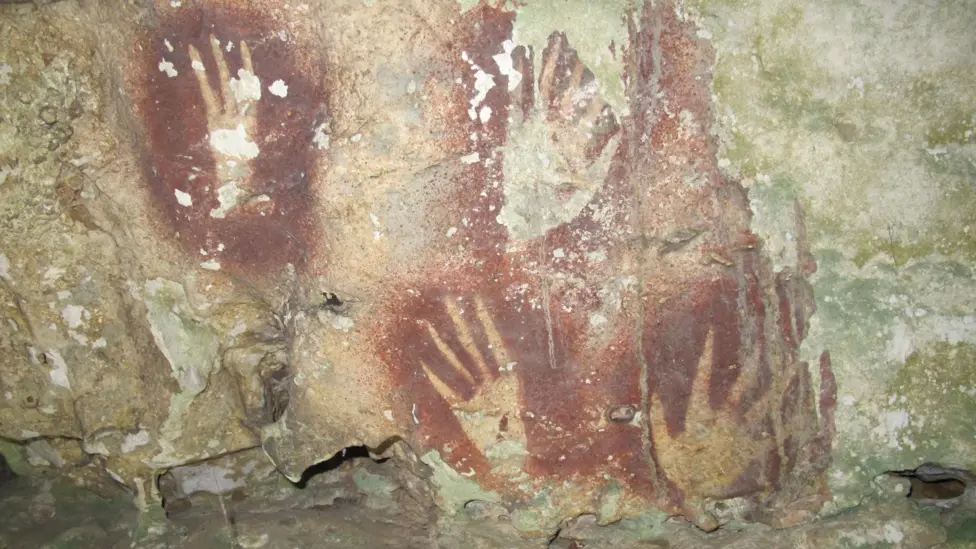
We learnt in the news this week that archaeologist and geochemist, Maxime Aubert (National Geographic & Griffith University, Australia), had discovered that the claw-like hand stencils in the cave on Muna Island, Indonesia, are at least 67,000 years old. This is the oldest rock art attributed to modern humans found so far.
Prehistoric humans that lived thousands of years ago did not learn to paint in a formal classroom, or in an art collage. To think that 67,800 years ago humans were creating artwork, with no art tools, art supplies, or even any written knowledge of art. This would mean that their skill were self taught through mastery, observation and practice. I find this quite an outstanding thought. I wonder what could we learn from looking at these artworks?
No art books, no written text, only the existing artwork on the cave walls to learn form. They would have had to observe the animals, and/or watch others painting. They would have had no paints, no brushes, no pens, etc. Any paints would have been created through experiment, using what they had in their local environment. Different colours and shades would be made by experimenting with pigmentation, and they would have also made their own tools for drawing/painting (all without previous knowledge). They would have had to practice on different types of surfaces, until they found the right surface and conditions for the paint to remain. Any Knowledge about making pigments, choosing cave surfaces, and the creation of art tools, could have only been through experimentation and/or being passed down verbally and/or shown in practice - and all without written language.
Their inspiration could have only come from observing things in their daily lives, such as animals in movement and humans hunting. They would have been self taught in their skills of art, showing that art education existed long before school or any written instructions. They also would have invented their own art materials, tools and paints. Natural pigments were used such as ochre, charcoal, and hematite, often on limestone walls. On top of all of this the actual paintings, themselves, are often found deep inside caves with no natural light. How did they discover all this?
Archaeological discoveries have shown that ancient cave painters would have used a range of simple but effective art tools, all made from natural materials. The ancient cave paintings show that early humans were not just focused on survival, but also deeply thoughtful, creative, and symbolic beings.
Learnt Skills:
Ancient cave painters would learn through a shared experience, observation, practice, and tradition, showing that art education existed long before schools or written instruction.
Learning by watching others: Skills would have been passed down by watching experienced painters. Often these would be elders or skilled members of the group.
Trial and error over generations: Techniques would be developed slowly. People experimented with different pigments, tools, and surfaces, learning what worked best.
Oral teaching and demonstration: Knowledge about making pigments, choosing cave surfaces, and preparing tools was probably explained verbally and shown in practice.
Community traditions and rituals: Painting may have been part of rituals or important events. Repeating these practices helped preserve and improve artistic skills within the group.
Learning from the natural world: They would have closely observed animals and movement in their daily life. This careful observation helped them represent forms accurately in their paintings.
Special roles within groups: Some individuals may have become specialist painters, gaining more experience than others and acting as teachers or leaders in artistic practices.
Memory and repetition: By repeatedly painting similar animals and symbols, artists strengthened their skills and ensured consistency in style and meaning.
Art Tools:
Discoveries show that ancient artists were highly inventive, using the materials around them to create artistic tools in order to create durable and expressive artworks that has lasted for thousands of years.
Drawing: Artists used fingers for drawing lines and spreading pigment, and hands for hand stencils
Brushes: Were made from animal hair, plant fibers, feathers, or chewed sticks, these allowed for more detailed lines and shading.
Blowing tools: Hollow bones or reeds were used to blow pigment onto the wall, especially for hand stencils and soft-edged effects.
Stone tools: Sharp stones were used to engrave or scratch outlines into the rock before painting, or to carve images directly into the cave walls.
Grinding stones and palettes: Flat stones were used to grind pigments into fine powder and mix them with binders. Some rocks show clear signs of repeated pigment use.
Lighting tools: Stone lamps filled with animal fat and wicks made from moss or fiber were found for working deep inside dark caves.
Typical Pigments
Ancient cave paintings used a very limited but powerful colour palette drawn entirely from natural, locally available materials. Despite the small range of colours, they were used with great sophistication. Colours were created by mixing pigments together and crushing them with a rock into a fine powder. To turn powdered pigment into paint, they would mix the powder with liquids such as animal fat, blood, water, saliva and plant juices or oils.
The most typical colour palette used in prehistoric cave art was red, black, yellow, and white. These were common colours due to the materials being naturally available, easy to process and proved to last. Earthly tones were mainly used, not because of limited creativity, but because these colours were practical, reliable, and long-lasting, whilst being perfectly suited to cave environments.
Red Pigment
Made from red ochre (from iron oxide), hematite. Red ochre was easy to find, bright and long lasting. This colour was often used for animal, humans and symbols. This is a rusty red colour, a brick red or a deep earthy crimson colour.
Yellow Pigment
Made from yellow ochre (from hydrated iron oxide). This was naturally available and easy to grind. This colour was often used for variation and highlighting. This is a mustard yellow with golden earth tones.
Black Pigment
Made from charcoal (from burnt wood), or manganese dioxide. This was strong and very durable. This colour was often used for outlines, shading and figures. This is a matte black to a soft charcoal grey.
White Pigment
Made from a natural limestone or a chalk. This colour was used less often, but helped with details and contrast. This is a chalky white, cream to a pale grey.

Mixing Colours
The pigments used had to be naturally available and easy to grind, and then apply. Iron based pigments have shown to last tens of thousands of years. These colours still work today as an earthy and grounding palette, as can be seen in the Mid-century modern design, and Scandinavian interiors.
Brown Pigments
The brown palette was created by mixing ochres and charcoal together. This colour was often used in shading or for animal fur. These would come from ochre, iron oxides, and clay.

Green Pigments:
Green could be made in a few ways, but it was also uncommon. Malachite (another copper mineral) produces green pigment when crushed. They have also mixed yellow ochre with black charcoal to create greenish tones.

Blue Pigments:
Blue was uncommon for prehistoric cave painters. The main possible source could have been azurite (a copper-based mineral), which can produce a deep blue when ground. In some regions, blue-green copper minerals may have been used, though evidence is limited.

Subject Matter
The subject matter of ancient cave paintings was closely connected to the lives, beliefs, and environments of early humans. Overall, ancient cave paintings focused on animals, survival, symbolism, and belief, offering insight into what early humans valued most in their world. Simplicity allowed focus on movement, form, and storytelling.
The most common subjects found to date being:
Large Animals: Would have been important for food, survival, and possibly spiritual beliefs. such as:
Bison
Horses
Deer
Cattle (aurochs)
Mammoths
Rhinoceroses
Hunting scenes: Some paintings show humans hunting animals using spears or traps. These scenes may have been used to teach hunting strategies or as part of ritual practices.
Human figures: Human figures are less common and often simplified or abstract. These may be more symbolic figures rather than realistic portraits. Such as:
Hunters
Dancers
Handprints and hand stencils: Many caves feature handprints, either painted directly or created by blowing pigment around a hand. These may have represented identity, presence, or participation in rituals.
Symbols and abstract signs: Their meanings are still debated but may relate to communication, counting, beliefs, or possible storytelling.
Dots
Lines
Zigzags
Spirals
Geometric shapes
Mythical or symbolic creatures: Some images combine human and animal features, suggesting early myths, spirits, or shamanic beliefs.
Natural features: Occasionally, artists incorporated the natural shapes of cave walls into their images, turning cracks or bumps into parts of animals or figures.
What have we learnt from these Paintings?
Daily life and survival: Cave paintings often show animals, hunting scenes, tools, and human figures. This tells us what people hunted, which animals lived in their environment, and how central hunting was to their survival.
Beliefs and spirituality: Many images seem symbolic rather than purely practical. Some caves are deep and hard to access, suggesting the paintings may have been linked to rituals, spiritual beliefs, or ideas about magic, fertility, or success in hunting.
Early artistic skill and creativity: The paintings reveal advanced artistic abilities: use of perspective, movement, shading, and natural contours of cave walls. This shows that creativity and aesthetic sense developed very early in human history.
Social organisation: Creating cave art likely required cooperation, by the gathering of pigments, preparing surfaces, lighting caves, and possibly teaching techniques. This suggests structured social groups and shared traditions.
Communication and storytelling: Before writing existed, cave paintings may have been a way to communicate stories, knowledge, or cultural values across generations.
Environment and climate: The animals depicted (such as mammoths or woolly rhinoceroses) provide clues about past climates and ecosystems that no longer exist in certain regions.
Human cognition: Cave art shows abstract thinking, planning, and symbolic expression - The key traits of modern human cognition.
Some samples of cave art
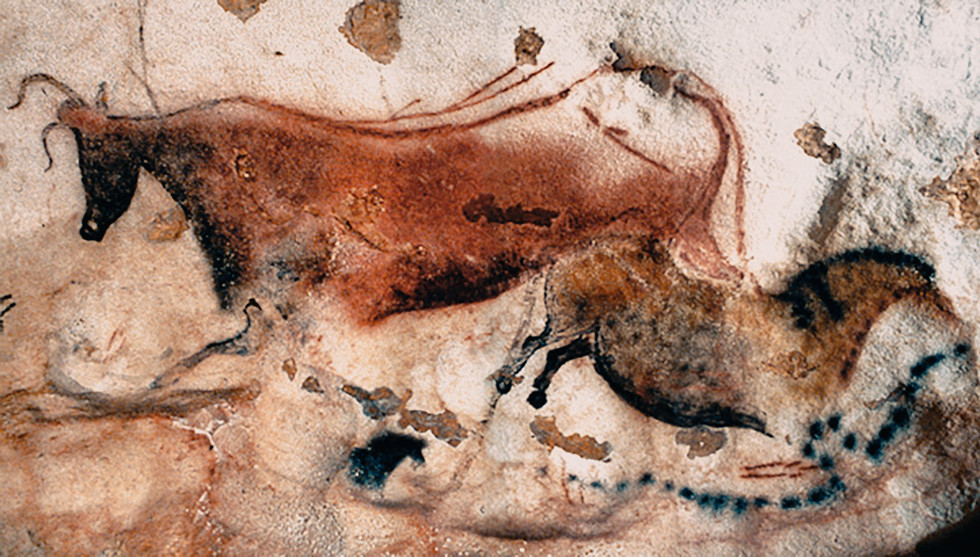
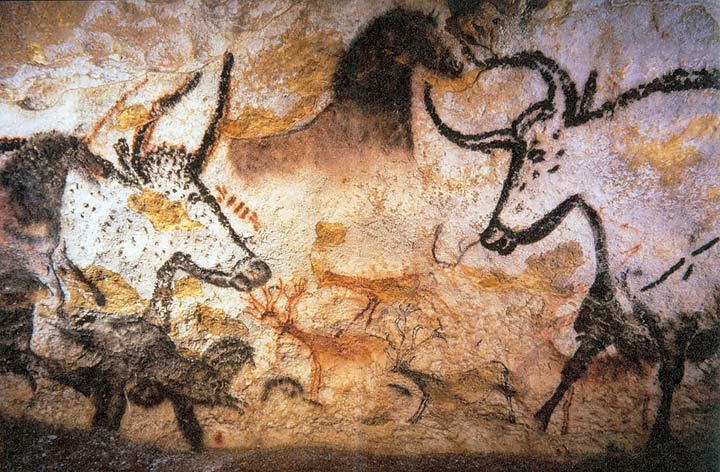
Lascaux Cave, Dordogne, southwestern France
17,000 years old
Lascaux Cave, in Dordogne, southwestern France, is one of the most important and spectacular prehistoric cave art sites. It was discovered in 1940 and it is thought to be around 17,000 years old (Magdalenian period). It contains over 600 painted figures and 1,500 engravings.
Subject matter being: Horses, bulls, deer, aurochs, abstract symbols
Style being: Naturalistic animal figures with dynamic movement
Technique being : Mineral pigments (reds, blacks, yellows), shading for depth
Colours used: Black, red, yellow, and brown ochre.




Altamira Cave, Cantabria, northern Spain
36,000 years old
Altamira Cave, located in Cantabria, northern Spain, is one of the most famous prehistoric cave art sites in the world and was discovered in 1868 (only art recognised in 1879). It is thought to be 14,000 - 20,000 years old (Upper Palaeolithic/ Magdalenian period).
Subject matter being: Bison, horses, handprints, geometric signs
Style being: Polychrome (multi-coloured) painting with relief effect
Technique being: Burnt bone and ochre pigments; layered colours
Colours used: Red, yellow ochre, and black


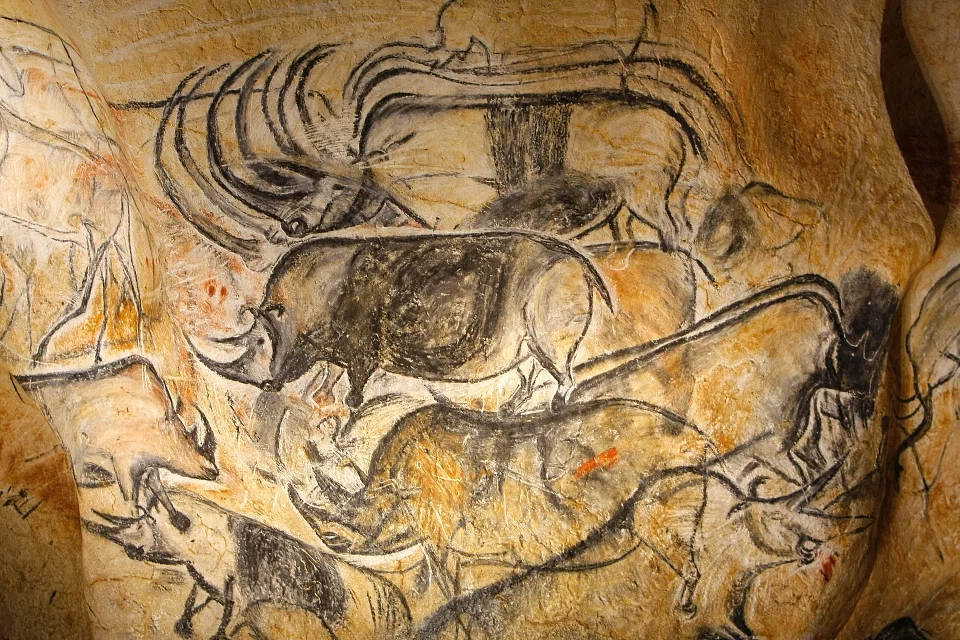
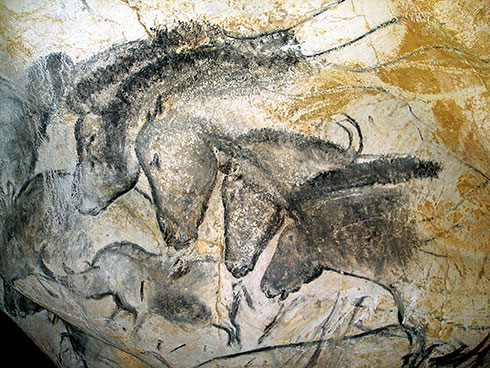
Chauvet Cave, Ardèche region, southern France
30,000-32,000 years old
Chauvet Cave is in the Ardèche region of southern France, and is one of the most important prehistoric cave art sites ever discovered. It was discovered in 1994. It is thought to be 36,000 years old (Aurignacian period).
Subject matter being: Lions, rhinoceroses, horses, mammoths, bison
Style being: Highly detailed, lifelike representations with motion
Technique being: Charcoal and ochre; advanced shading and perspective
Colours used are: Mainly black and red ochre.



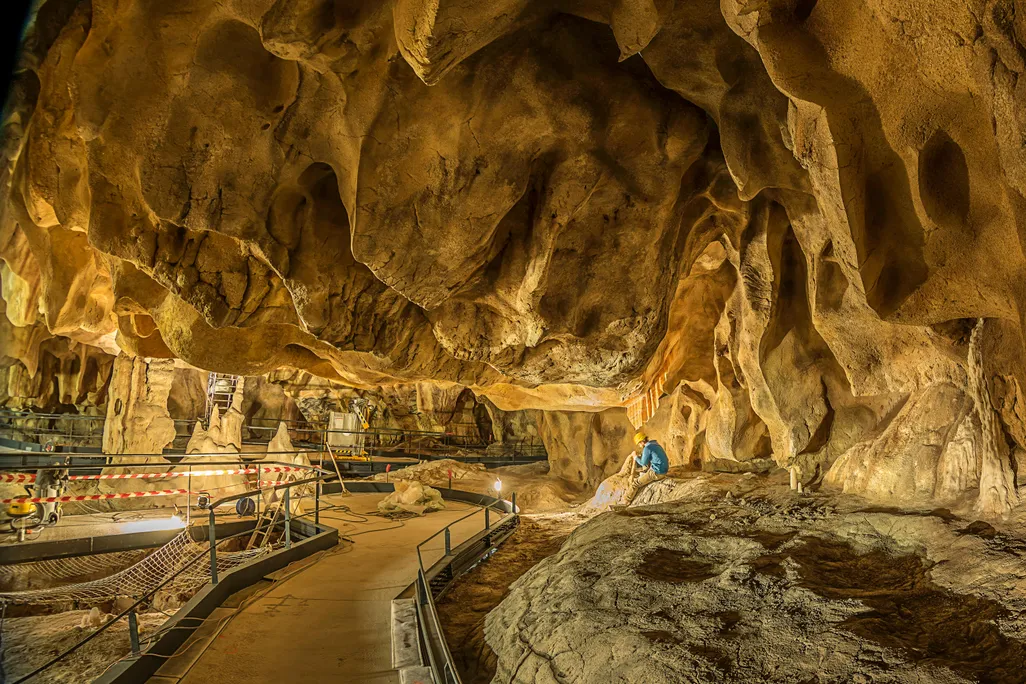
Cave of El Castillo, Cantabria, northern Spain
40,800 years old
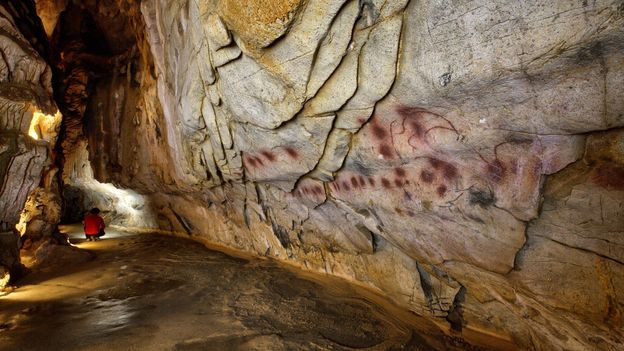
Cave of El Castillo is located in Cantabria, northern Spain. It is one of the oldest and most important prehistoric cave art sites in Europe. It was discovered in 1903. It is thought to date to at least 40,000 years old.
Subject matter being: Red disks, hand stencils, animal figures
Style being: Abstract and symbolic marks alongside figurative art
Technique being: Pigments applied by brushes, blowing, or stamping hands
Colours used: Red ochre and some black

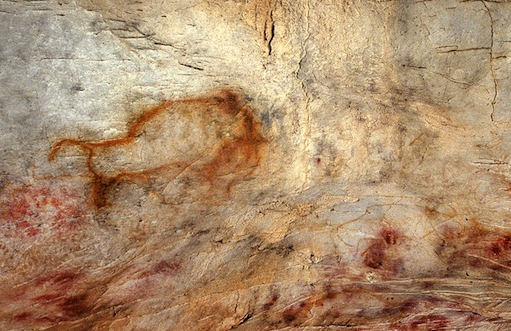

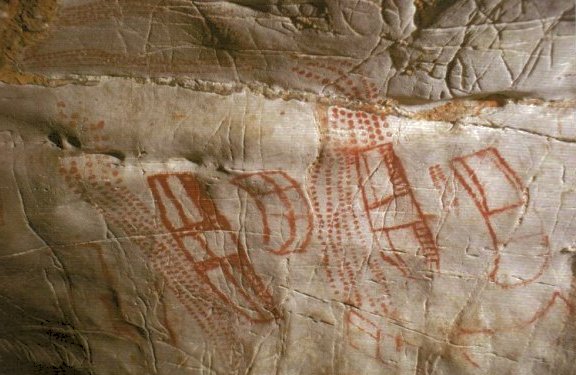
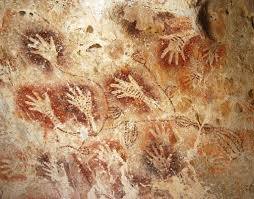

Sulawesi Caves, Sulawesi Island, Indonesia
45,500 years old
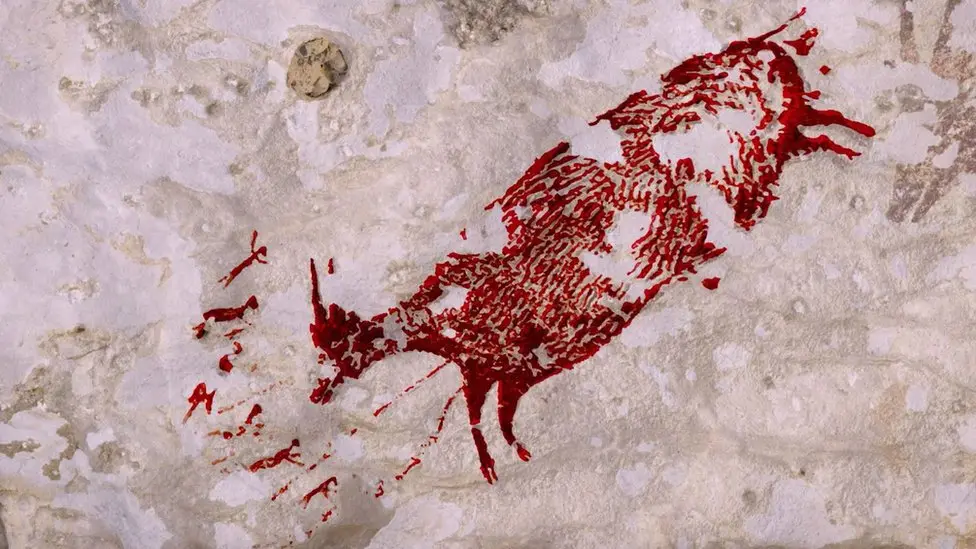
Sulawesi Caves, on Sulawesi Island, Indonesia, contain some of the oldest known figurative cave art in the world, showing that early art was a global phenomenon, not just European. It was discovered in 2010 (although some of the hand stencils are believed to be even older).
Subject matter being: Figurative animal paints, hand stencils, and wild pigs
Style being: Early symbolic and figurative art in Asia
Technique being: Pigments applied with blowing and brush techniques
Colours used: Mostly red ochre, with some black pigment.


Liang Metanduno, Muna, South Eastern Sulawesi
40,00 - 67,800 years old
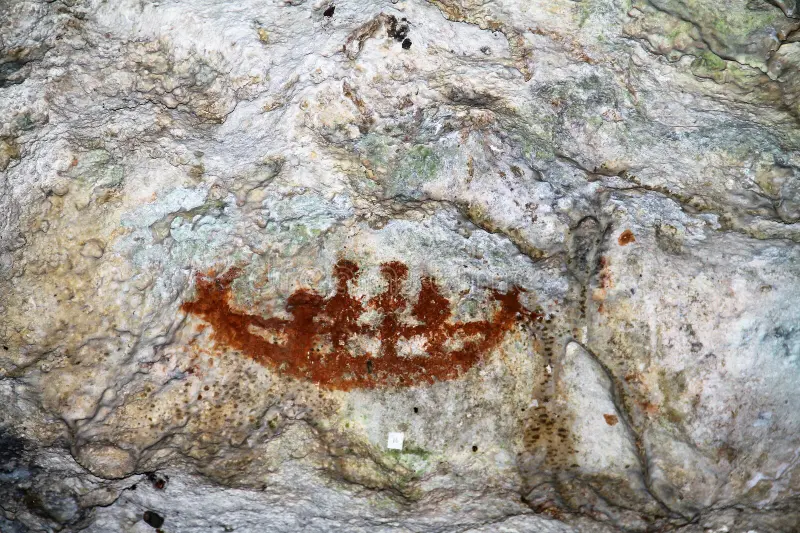
Liang Metanduno, located on Muna Island, South-Eastern Sulawesi, in Indonesia. It is an important prehistoric cave art site that adds to our understanding of early human creativity in Southeast Asia. It is thought to be 40,00 years old. Although known locally for some time it was only recently (January 2026) announced that some of the stencils have been dated at 67,800 years old. Making this cave the oldest cave artwork to date.
Subject matter being: Hand stencils
Style being: Stylistic choices hint at complex symbolic thinking.
Technique being: Placing a hand on the wall and blowing or spraying pigment around it.
Colours used: Primarily red ochre, with occasionally darker tones from charcoal.


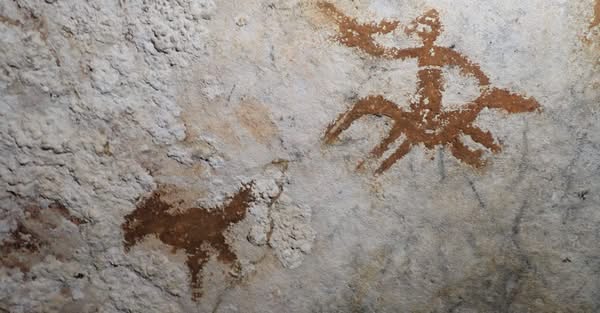
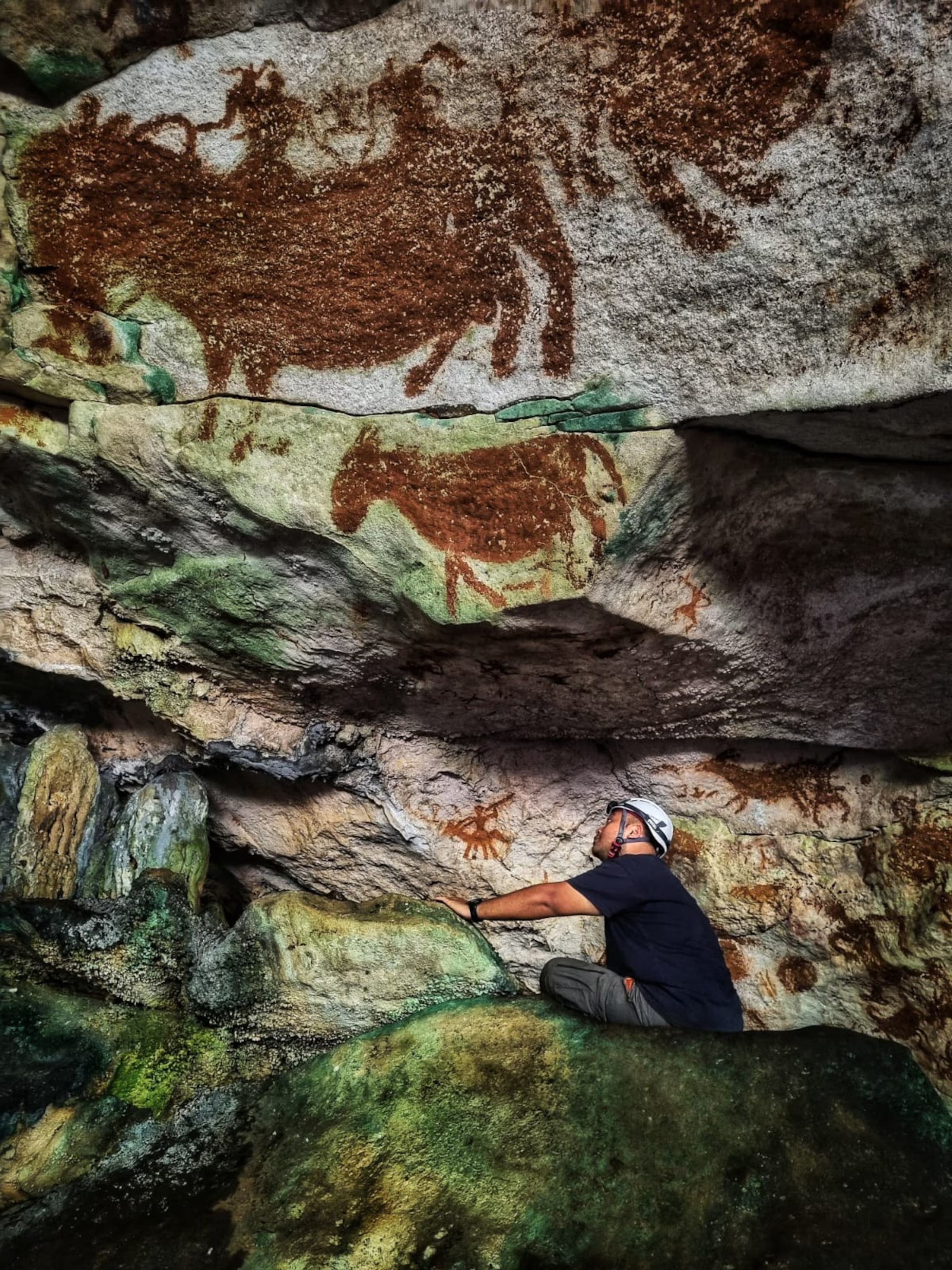
We have learnt that prehistoric humans had an advanced observation and realism, and that the cave artists were remarkably skilled observers. The cave paintings show animals such as bison, horses, and deer drawn in accurate proportions, movement, and behaviour. This tells us that they deeply understood the natural world around them.
We can also see that they had excellent technical skills and planning. They prepared their own pigments from minerals, used homemade brushes, their fingers, and hollowed blowpipes. They also carefully chose cave surfaces to enhance depth and shape. Some artworks required scaffolding, showing planning and cooperation.
We have learnt that they used symbolism and abstraction. Alongside realistic animals, hand stencils have been found, geometric patterns, and abstract signs. These suggest symbolic thinking. The human's were expressing ideas, identities, or beliefs, not just copying what they saw.
They had a cultural and social meaning. The art likely played an important role in their social life. Many scholars believe it was connected to rituals, storytelling, spiritual beliefs, or teaching younger members of the group. This shows that art was part of shared culture, not just individual expression.
We now understand that they had communication before writing. Cave art acted as an early form of communication. It allowed prehistoric humans to pass on knowledge across generations, long before written language existed.
Their artworks shows creativity and imagination. Some of the paintings combine human and animal features or depict animals rarely hunted. This points to imagination and possibly myth-making, showing that prehistoric humans thought creatively and abstractly.
Prehistoric cave art reveals that early humans were not intellectually or artistically primitive. We have learnt from these ancient cave paintings that they had rather sophisticated technical skills, symbolic thought, creativity, and complex social lives.
Colour Pigment Palette (Hex Codes)
For those of you interested in trying out your own artwork using the prehistoric colour palette, I have made up some simple hex codes for you to experiment with.
Typical Pigment Palette:
#8C3A2E Ochre Red
#A0522C Burnt Sienna
#C8A24D Yellow Ochre
#2B2B2B Charcoal Black
#E6E2D9 Limestone White
Brown Pigment Palette:
#6B3E26 Dark Ochre Brown
#8C3A2C Red-Brown Ochre
#593A1E Burnt Earth Brown
#794A2E Clay Brown
#4E362A Umber-like Brown
Green Pigment Palette:
#6A6F3F Earthy Olive Green
#5F6B4A Moss Green
#6B7A4F Mineral Green
#7A8450 Weathered Green Stone
Blue Pigment Palette:
#5B6E73 Stone Blue-Grey
#6C7A7F Ashy Blue
#4F646A Faded Slate Blue
Reference:
Image Source:
National Geographic
BBC News
Smithsonian
Nature
Bradshaw Foundation
Interesting Articles:
Rachel Goodchild | Design Blog
Creating Pattern for Textile, Product, Home & Packaging


